

I want to dive into a topic that’s fundamental to everything we do in electronic music production, yet it can often be a source of confusion: compression. Specifically, I want to talk about the different types of compressors we have at our fingertips in the digital world and how to choose the right one for the job.
I’ve been experimenting a lot recently with the different compressor models available in modern DAWs and plugins. We’re spoiled for choice, with emulations of classic hardware that each have their own unique character and behaviour. With this post, I’m not here to talk so much about ‘how’ to use a compressor—the basics of threshold, ratio, attack, and release—but rather offer an insight into the different flavours that each style of modelled compressor brings to the table. Understanding these sonic differences can take your mixes from good to great, adding that elusive punch, glue, and polish that we all strive for.
So, let’s break down some of the most common compressor types and explore where they shine in a modern production workflow.
The Clean Machines: Feed-forward & VCA
Let’s start with the more transparent and precise options.
Feed-forward compressors are the workhorses of surgical mixing. They analyze the input signal before it gets compressed, which makes them incredibly predictable and precise. This is your go-to for technical tasks like de-essing, taming harsh resonances, or controlling a specific element without adding much colour. Think of it as a tool for problem-solving rather than creative colouration.
Then we have the VCA (Voltage Controlled Amplifier) compressor. Based on iconic hardware like the SSL Bus Compressor, VCA models are known for their clean, punchy, and “gluey” character. This is the sound of countless hit records.
- On the Drum Bus: This is where the VCA really shines. It has a magical ability to bring all your drum elements together, making them sound like a cohesive unit. It’s that “smack” and “punch” you hear in everything from classic house tracks to modern techno.
- On the Mix Bus: A VCA compressor is often the final touch on a mix, providing that gentle “squeeze” that makes everything feel polished and professional.
The Vintage Vibes: Optical & Tube
Now let’s get into the more colourful and characterful compressors.
The Optical compressor is all about smooth, gentle, and musical compression. It emulates the behaviour of a light source and a photoresistor, which results in a slower, more program-dependent response. The louder the signal, the more it compresses, but it does so in a very natural-sounding way.
- For Vocals and Bass: An Optical compressor, like the classic LA-2A it’s often modelled on, is perfect for smoothing out the dynamics of a vocal performance or a bassline without killing the vibe. It’s the secret to that warm, consistent, and “in-your-face” sound.
The Tube compressor is your go-to for adding warmth, weight, and harmonic richness. Based on vintage gear from the 1950s, these models introduce subtle saturation that can bring a digital sound to life.
- On Bass and Synths: A Tube compressor can add a beautiful harmonic character to a synth pad or a bassline, helping it sit perfectly in the mix and giving it a sense of analogue warmth.
The Aggressive Animals: FET
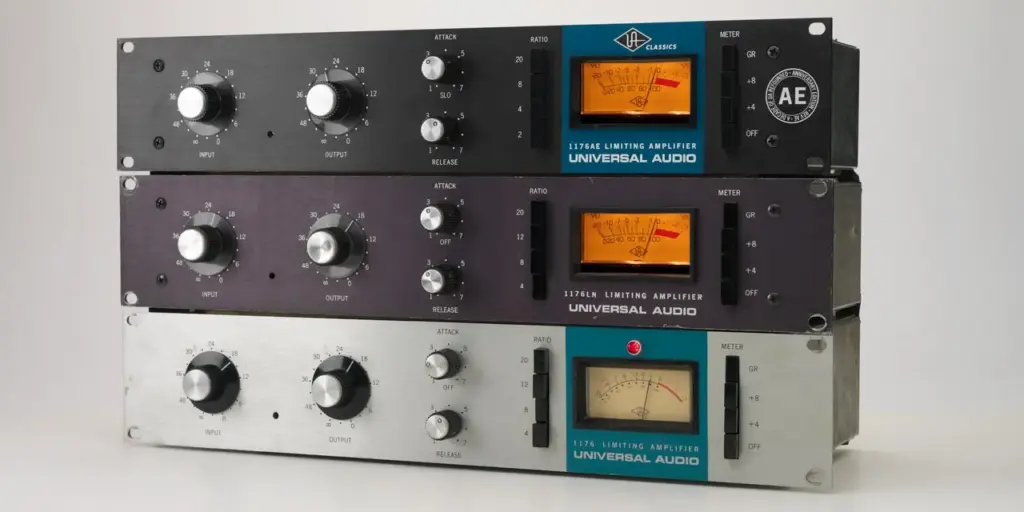
When you need something fast, aggressive, and full of character, you reach for a FET (Field-Effect Transistor) compressor. Modelled on the legendary 1176, FET compressors are known for their lightning-fast attack times and distinctive sonic signature.
- For Drums and Parallel Processing: A FET compressor is a monster on individual drum sounds, especially kicks and snares. It’s the sound of aggressive, punchy drums that cut through a dense mix. It’s also a favourite for parallel compression, where you blend a heavily compressed signal with the dry signal to add excitement and energy. You can hear this technique all over modern electronic music, from explosive, in-your-face drums to the driving rhythms of heavy bass music. Many top-tier producers rely on aggressive parallel processing to achieve a signature, detailed sound, and the FET compressor is a perfect tool for this.
The Modern Approach: Beyond the Models
Of course, in today’s electronic music, the lines between these compressor types are often blurred. Many producers use a combination of techniques and models to achieve their sound.
For example, the “pumping” sidechain compression effect, so prevalent in house, techno, and beyond, is often achieved with a simple stock compressor. A common professional technique involves applying sidechain compression over an entire mix, triggered by a short, separate kick sample, to create a unique groove and swing. Similarly, many producers are famous for their intricate use of sidechaining, often using “ghost kicks”—a muted kick drum on a four-to-the-floor pattern—to trigger the effect and create rhythmic space in their mixes.
What’s important is to understand the fundamental characteristics of each compressor type and then experiment to see what works for your music. Don’t be afraid to push the settings and see what happens. The best producers are often the ones who break the rules.
Final Thoughts
I hope this breakdown has been helpful. Remember, these are just guidelines, not rules. The best way to learn is to get your hands dirty and experiment. Load up your favorite compressor plugin, cycle through the different models, and listen to how they affect the sound.
Compressor Recommendations for Electronic Production
| Part / Instrument | Recommended Model(s) | Reasoning & Use Case |
| Kick & Snare | FET, VCA | Use a FET for aggressive punch, character, and fast transient control. ⚡ Use a VCA for a cleaner, tighter, and punchy sound that’s more transparent. |
| Drum Bus / Group | VCA, FET (Parallel) | The VCA is a classic for “gluing” drum elements together, adding cohesion and punch to the overall group. Run a FET in parallel for extreme, exciting character. |
| Bass | Optical, Tube | An Optical compressor is perfect for smooth, gentle leveling that keeps the bass consistent without killing the dynamics. 🎶 A Tube model adds desirable warmth and harmonic saturation. |
| Synths (Leads, Arps) | FET, VCA | A FET will make a lead synth aggressive and help it cut through the mix. A VCA offers transparent dynamic control, reining in a synth without overly coloring the sound. |
| Synths (Pads, Atmospheres) | Optical, Tube | Use an Optical compressor for gentle, transparent leveling to smooth out the dynamics of evolving pads. A Tube model can add warmth and vintage character. |
| Vocals | FET → Optical | This is a classic vocal chain. Use the FET first with a fast attack to catch and control sharp peaks. Follow it with the Optical to provide smooth, overall leveling. ✨ |
| Mix Bus / Master | VCA | The VCA is the go-to for mix bus compression. It provides the final “glue” that makes a track sound cohesive, polished, and punchy without being too aggressive. 🏆 |
| Surgical / Corrective | Feed-forward | When you need precise, predictable control (like for de-essing or taming a specific resonant frequency), the Feed-forward model’s direct input detection is ideal. 🔬 |
| General Musical Color | Feedback, Tube | For general-purpose compression where you want a “musical” response that reacts to the output, the Feedback model is great. For adding warmth and vintage vibe, use the Tube |