
If we look at this purely from a logical, operational standpoint, what I am currently doing to my studio makes absolutely no sense.
I just migrated my entire production hub over to an M5 MacBook Pro. It has a terrifying amount of processing power. I could load up two hundred tracks of highly detailed, component-modeled virtual instruments, run them all through digital emulations of hundred-thousand-dollar mixing consoles, and the CPU meter wouldn’t even flinch.
Everything I could possibly ever need to write, mix, and master a track is sitting right there, self-contained, “in the box.” It is peak efficiency. It is the sterile, perfect dream we were promised in the late 90s when DAWs first started replacing hardware tape machines.
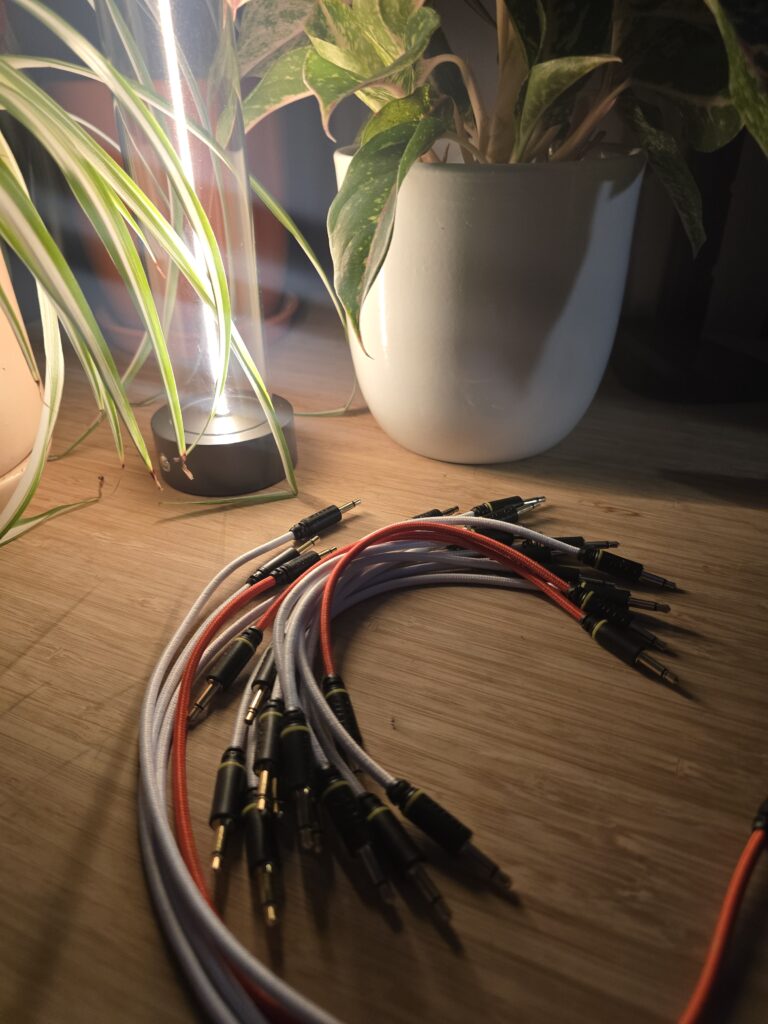
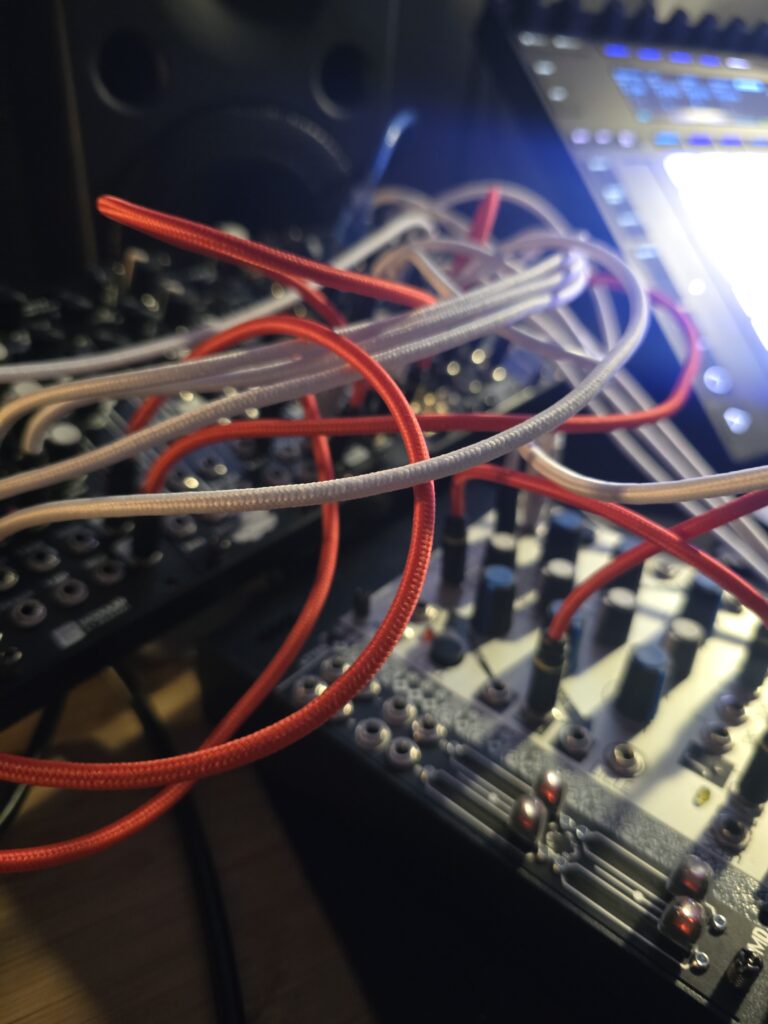
So, why is my desk currently covered in patch cables, power supplies, and outboard sequencers?
Because I have realised that ultimate efficiency is the enemy of my creative process, I am deliberately breaking my perfect digital setup to build a hybrid workflow. Not because I have to, not because I need to – but because I want to get back to a completely different way of working.
The Tyranny of the Mouse
When you spend your entire working day staring at a screen, sending emails, and managing spreadsheets, your brain locks into a very specific, task-oriented gear.
If you log off from work, open Ableton Live, and immediately grab your mouse to start clicking MIDI notes into a piano roll, your brain doesn’t register a change in environment. You are still just clicking boxes on a grid. You are still spreadsheeting.
Music production in the box has become incredibly visual. You look at EQ curves, you look at waveforms, and you look at automation lanes. When you can see the music, you stop actively listening to it. You start mixing with your eyes, aligning blocks on a screen because it looks mathematically correct, rather than closing your eyes and feeling if the groove actually swings.
The iPad Problem and 1:1 Mapping
This reliance on screens reminds me of my time setting up high-end home theatres professionally. It was right around the time touchscreen tablets were becoming the norm. Suddenly, every client wanted to control their entire cinema room via a shiny new iPad.
The issue became obvious immediately. If you are deeply engrossed in a movie in a dark room and a loud explosion hits, you instinctively want to reach down and turn a physical volume dial. But with an iPad, you have to look away from the movie, wake up the tablet, locate the app, look at the screen, and slide a virtual fader. It pulls you completely out of the film and forces you to focus on the equipment, rather than the experience.
The modern DAW suffers from the exact same fatal flaw. If I want to change a cutoff on a filter during a jam, I do not want to break my concentration to stare at a monitor, open a VST window, and drag a cursor.
The standard counter-argument here is, “Just buy a MIDI controller.” And sure, MIDI controllers are great. I have a Push 2 here. Awesome bit of kit. But mapping generic rotary encoders to constantly changing software parameters still requires a cognitive leap. You always have to remember what page you are on and what generic knob controls what parameter today. A true one-to-one mapping—where a specific physical knob is permanently hardwired to a specific acoustic function—is the ultimate interface. That is what dedicated hardware provides. It allows you to build muscle memory and mix without ever having to look down.
Introducing Intentional Inefficiency
Moving back to hardware—specifically the physical, electrical world of modular synthesis—introduces a massive amount of friction into the workflow.
If I want a synthesizer sound in Ableton, I drag a VST onto a track, load a preset, and I am done in three seconds.
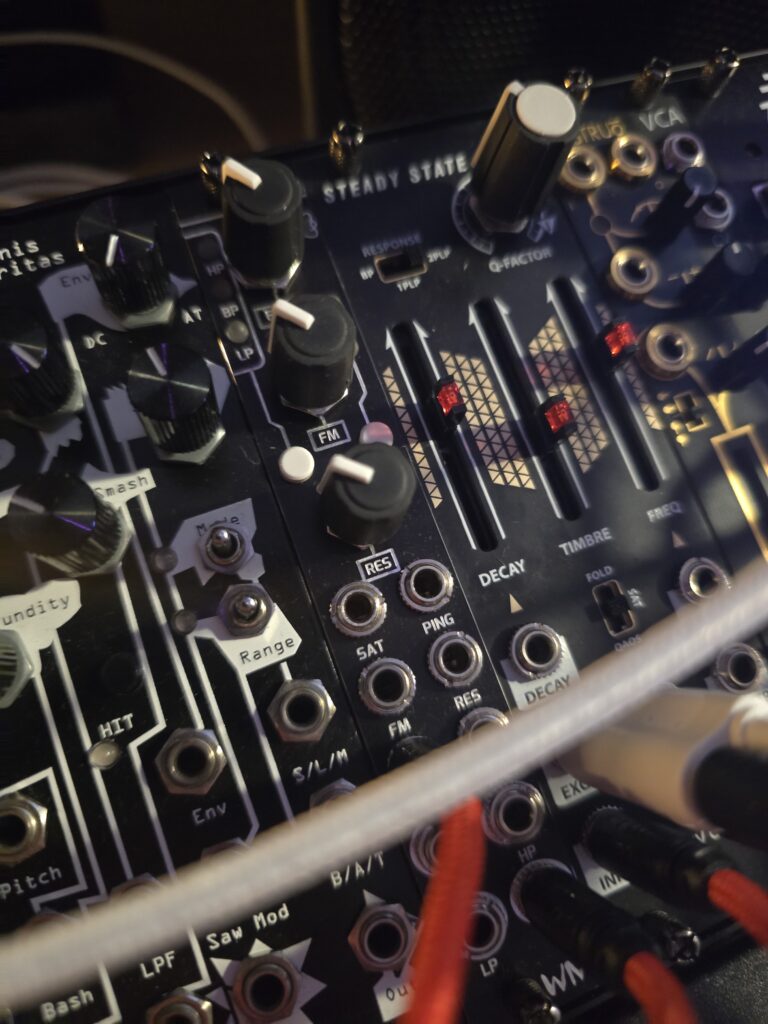
If I want a synthesizer sound on my physical rack, I have to route a pitch cable from a sequencer into an oscillator. I have to route the audio out of the oscillator into a filter, and then into a VCA. I have to generate an envelope, patch that into the VCA to shape the volume, and patch an LFO into the filter to give it movement.
It takes ten times as long. It is inherently, deliberately inefficient.
But that inefficiency is exactly where the magic happens. While you are physically plugging those cables in, you are committing to the sound. You are making tactile, physical decisions. You turn a physical potentiometer with your fingers, and you hear the filter sweep respond in real-time. The resistance of the knob creates a physical connection to the audio that a plastic mouse click can never replicate.
The “Why Make It Harder?” Question
The amount of times people have looked at the mess of cables on my desk recently and asked, “But why? This looks so much harder than just using a VST!” is staggering.
They are absolutely right. It is harder. It is infinitely more complicated.
But that complication is deeply rooted in physical reality. Recently, one of my daughters was studying wavelengths, amplitude, and oscillations as part of a STEM project for school. Because I have a desk covered in modular hardware, I got to go full audio-nerd. I started explaining how her textbook physics translated directly into the Low Frequency Oscillators (LFOs) and voltage-controlled oscillators patching right in front of her.
Her eyes glazed over in about thirty seconds.
She didn’t care about the underlying math, and I can’t blame her. But when I physically patched that LFO into a filter cutoff, turned the amplitude up, and the synth started aggressively growling and physically shaking the desk monitors—she understood the result. She could see the cable, touch the knob, and feel the physics happening in the room.
You simply do not get that visceral connection to the physics of sound by dragging a digital slider on a computer monitor.
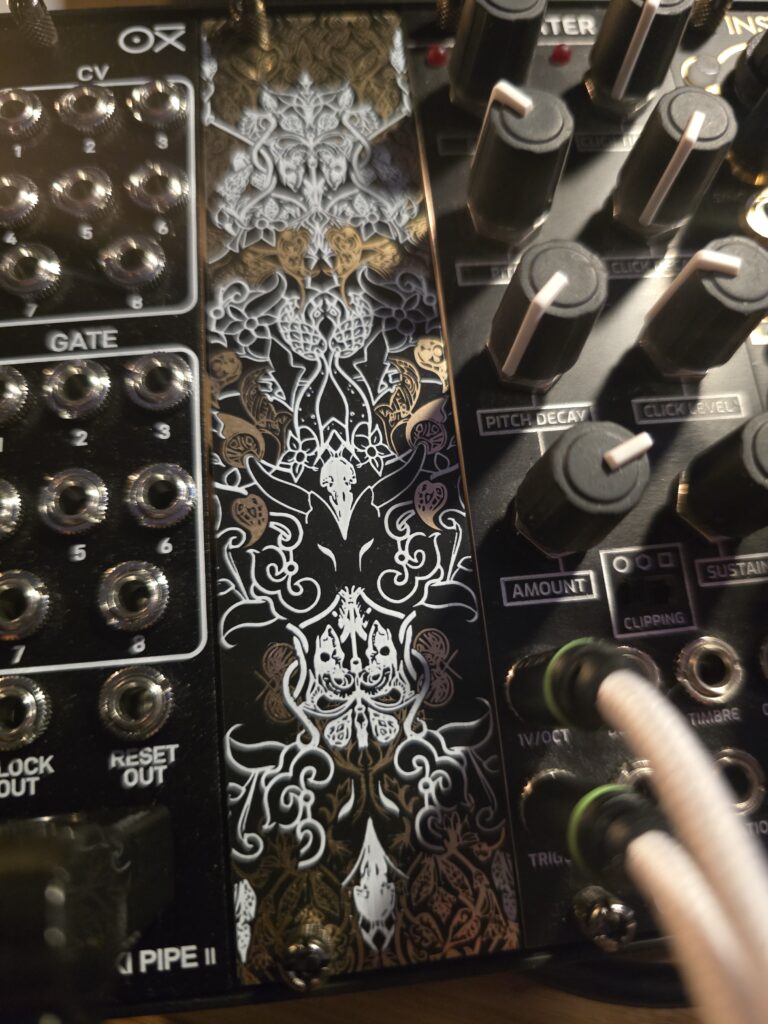
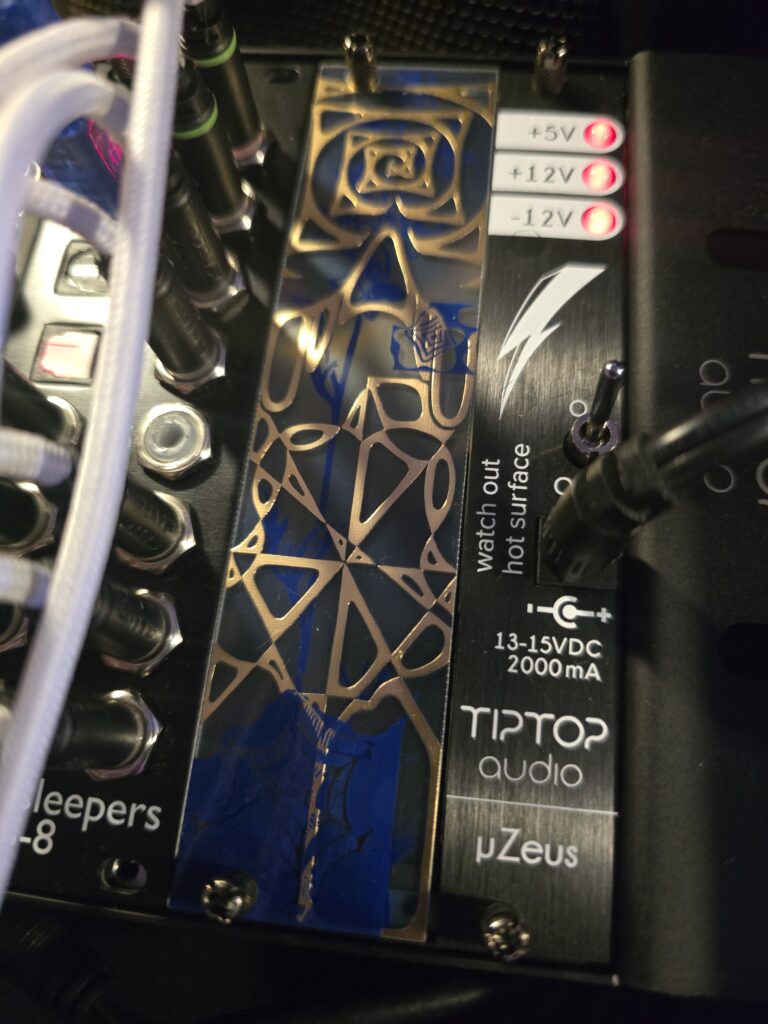
The Ephemerality of the Patch
The other massive benefit of a hybrid hardware setup is the lack of an “Undo” button.
In a DAW, every decision is infinitely reversible. You can save a hundred different versions of a project. You can change a synth patch three years after you originally wrote the MIDI melody. This breeds a specific kind of digital paralysis. Because you can always change it later, you never actually commit to it now. Tracks die a slow death by a thousand microscopic tweaks.
When you wire up a complex patch on a modular synth, it is ephemeral. It exists only for the exact moment the cables are plugged in. If you pull a single cable out, that exact sound is gone forever. You can try to recreate it tomorrow, but the analog components will react slightly differently. It will never be exactly the same.
This forces you to act. If it sounds good, you cannot save the preset. You have to hit record right now. It injects a sense of live urgency back into the studio.
The Hybrid Compromise
To be clear, I am not a purist. I am not abandoning the computer entirely to record onto analog tape. The goal is a true hybrid ecosystem that utilizes the absolute best of both worlds.
The hardware—the modular gear, the Oxi One sequencer, the distortion pedals—is for the writing phase. It is the chaotic, hands-on, unrepeatable paint.
The computer—the M5 Mac, the Topping DX5 II DAC, the planar magnetic headphones—is for the arrangement and mixing phase. It is the surgical scalpel and the tape machine.
I want to sit at the desk, keep my hands off the mouse, and lose myself in the hardware for an hour. I will record that chaotic audio directly into Ableton. Then, when the creative, tactile phase is over, I can switch back into the analytical mindset, chop up the audio, and finish the track. It is the ultimate cure for DAW fatigue.