
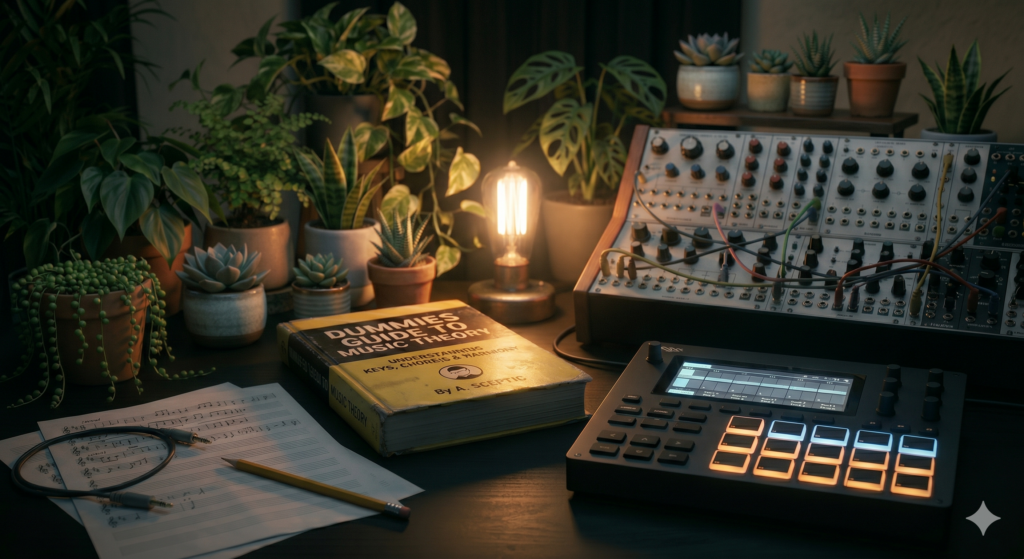
I have been a producer for a long time, but I will be the first to admit that my relationship with formal music theory has always been largely instinctual.
I know what sounds right when I hit a key. I know how to dial in the tuning of an analogue oscillator, and I know how to pitch a sample down until it locks into the groove. But when you start throwing around terms like Phrygian dominant scales or diminished sevenths, my eyes tend to glaze over. I am an engineer, not a classically trained pianist.
However, bringing the Oxi One MK II sequencer into the studio has forced a reckoning.
The Oxi One has an incredible “Chord Palette” mode. It is essentially a cheat code for harmony, allowing you to trigger complex, beautiful chord progressions with a single finger. I have been spending hours just playing around with these palettes, listening to how the different chords interact and push against each other.
But it sparked a fundamental, operational question that I realized I couldn’t definitively answer: How do these chords actually sit within the master structure of a musical Key? If I am playing a minor chord, does that mean my Ableton project has to be in a minor key? Can I play a major chord inside a minor key? Do I set my other sequencers to follow a master key, or do they have to follow the specific chords?
If you are a hardware producer who relies on your ears rather than a sheet of music, here is the dummy’s guide to understanding the blueprint of harmony.
The Key: The Master Blueprint
Think of the “Key” of a song as the master blueprint for a construction site.
The Key defines the absolute boundaries of the project. It gives you a specific set of seven notes (out of the 12 available notes in Western music) that sound good together. That set of seven notes is called a Scale.
If your song is in the Key of C Major, your scale is C, D, E, F, G, A, and B. Those are the white keys on a piano.
The Key provides the gravity. No matter where you wander off to during a melody or a bassline, the listener’s ear will always want to return to the “root” note of the Key (in this case, C) to feel a sense of resolution and home.
The Chords: The Building Blocks
If the Key is the master blueprint, the Chords are the physical bricks and timber you use to build the house.
A chord is simply three or more notes played at the exact same time.
Now, here is where the confusion usually starts: Chords are built using the notes provided by the Key.
Let’s stick with our C Major blueprint (C, D, E, F, G, A, B).
If you want to build a chord starting on the first note (C), you take the C, skip the D, grab the E, skip the F, and grab the G.
You are now playing the notes C – E – G.
Because of the mathematical distance between those specific notes, that combination produces a happy, stable sound. That is a C Major chord.
Now, let’s build a chord starting on the second note of our C Major blueprint (D). You take the D, skip the E, grab the F, skip the G, and grab the A.
You are now playing the notes D – F – A.
Because of the math between those specific notes, the sound is sadder and slightly more tense. That is a D Minor chord.
The Big Question Answered
Can you have a Minor Chord within a Major Key?
Yes. Absolutely. In fact, you must.
When you lock Ableton (or your Oxi One) into a master Key (like C Major), the sequencer automatically calculates the math for you. It looks at the seven available notes in that blueprint, and it automatically builds the correct chords for each step of the scale.
Within any Major Key, the chords naturally occur in this exact pattern:
- Major
- Minor
- Minor
- Major
- Major
- Minor
- Diminished (A weird, highly tense chord we generally ignore in dance music).
So, if your master project is in C Major, and you press the second chord in the palette on your Oxi One, you are playing a D Minor chord. It sounds perfect because it is built entirely out of the approved notes from the C Major blueprint.
Why Electronic Music Loves Minor Keys
Sidebar: If you analyze the top 100 underground techno or tech-house tracks, almost 90% of them will be written in Minor keys. Major keys sound inherently happy, triumphant, and resolved. Minor keys sound tense, unresolved, dark, and melancholic. Because club music is fundamentally about building and releasing tension over long periods on a dark dancefloor, the unresolved math of the Minor scale is the perfect emotional vehicle.
The Minor Key Blueprint
What happens if we switch the vibe? In underground dance music, we rarely use Major keys. They are too happy. We live in the Minor keys because they are dark, moody, and serious. We like to pretend we are dark moody and serious as well.
Let’s switch our master blueprint to A Minor.
The notes for A Minor are A, B, C, D, E, F, G. (Notice these are the exact same notes as C Major, just starting in a different place. They are “relative” keys).
If you build a chord starting on the first note (A), you get A – C – E. That is an A Minor chord.
If you build a chord starting on the third note (C), you get C – E – G. That is a C Major chord.
Can you have a Major Chord within a Minor Key?
Again, yes. The natural pattern for chords built within a Minor Key is:
- Minor
- Diminished
- Major
- Minor
- Minor
- Major
- Major
Modes (Phrygian, Dorian, etc.): Moving the Starting Line
You mentioned Phrygian. Things like Phrygian, Dorian, and Mixolydian are called “Modes.”
Do not let the Greek names intimidate you. A Mode is simply taking your standard master blueprint and deciding to start building your house from a different corner.
If you take the C Major scale (C, D, E, F, G, A, B) but you force the listener’s ear to treat the third note (E) as the “home” base instead of C, you are now playing in the E Phrygian mode. It uses the exact same notes, but because the gravity has shifted to E, it sounds incredibly dark, exotic, and tense. (Phrygian is the absolute holy grail for dark techno and modern Tech-House).
How to Set Up Your Studio Architecture
Now, how does this apply operationally when you are staring at the Oxi One and Ableton Live?
1. Set the Master Key
Decide the overall vibe of your track. If you want dark and rolling, pick a Minor key (like F Minor). Set this Master Key in Ableton’s control bar, and set your Oxi One’s global scale to F Minor.
2. Play the Chord Palette
Because the Oxi One is now locked to F Minor, every chord you trigger in the palette will automatically be mathematically correct for that blueprint. It will give you a mix of Minor and Major chords, but they will all belong to the F Minor family. You cannot hit a wrong note.
3. Sequence the Bass and Leads
Here is the crucial part: When you are writing your bassline or your lead synth on another sequencer, they must follow the Master Key, but they should acknowledge the Chords.
If your master key is F Minor, your bassline sequencer must be locked to F Minor.
However, if your Oxi One is currently playing the 3rd chord in the sequence (which, in F Minor, is an A-flat Major chord), your bassline will sound strongest if it hits an A-flat note at that exact same time.
You don’t have to change the key of your bassline sequencer every time the chord changes. The Master Key (F Minor) is the umbrella that covers everything. As long as all your machines are locked to the F Minor scale, nothing will clash horribly. But aligning the root note of your bassline with the root note of the specific chord playing at that moment is what turns a random sequence of notes into a powerful, cohesive groove.
Music theory doesn’t have to be a rigid academic exercise. It is just a set of operational parameters. The Oxi One does the heavy mathematical lifting for you; you just need to understand the blueprint so you can decide where to place the bricks.
Option 3: The Bassline Rule of Thumb
Sidebar: When programming a bassline under a complex chord progression, you don’t need to overthink it. The simplest, most effective rule is: whatever the root note of the current chord is, play that note on the bass synth. If the Oxi One is playing a D Minor chord, have your bassline hit a D. It anchors the harmony perfectly. Once you have that anchor locked in, you can start programming syncopated passing notes around it to build the groove.