
There is a “new” trend making the rounds on social media right now. Across TikTok and Instagram Reels, a wave of influencers, ravers, and even DJs themselves are posting hot takes and manifestos urging people to do the unthinkable: Turn your back on the DJ.
The pitch is that we should stop staring at the stage like we are at a rock concert, turn to face the dancefloor, and actually connect with the people around us.
If you have been in the electronic music scene for more than a minute, this sudden revelation might give you a mild case of whiplash. The phenomenon of the crowd staring blankly forward at the DJ booth isn’t a new problem. In fact, it has been suffocating club culture for nearly thirty years. What is “new” is that rebelling against it has suddenly become highly engaging, bite-sized content.
There is a rich, tragic irony in all of this. The very concept of putting your phone away and being present in the moment is currently being weaponized as algorithmic content for people to consume on their phones. And yes, the dichotomy isn’t lost on me. I deeply dislike what social media has turned into and how it attempts to shape our behavior, yet here I am, actively engaging with that exact same platform to share this thought.
I was actually sure I had already written this exact article. And it turns out, I had. A few months ago, while I was transitioning my writing from thebloke.co.nz over to the new bromide.nz website, I penned an early version of this on the old site that has since been turned off. But seeing this trend suddenly explode online made me realize it was time to dust it off, update it, and put a few more thoughts down. The conversation feels even more appropriate right now.
As someone who has been complaining about this shift for decades, I can’t help but chuckle.
We didn’t just invent the inward dancefloor. We simply forgot it.
Mark’s One-Man Revolution
When I was first getting into DJing and pro-audio back in the 90s, the concept of “facing the DJ” wasn’t just unpopular; in many venues, it was physically impossible. The DJ booth wasn’t an altar. It was usually tucked away in a dark corner, obscured by jungle netting or a relentless fog machine.
But as the early 2000s rolled around, that started to shift, and the crowd slowly began pivoting forward. I had a mate, Mark, who absolutely refused to accept this new paradigm. His entire clubbing MO was a masterclass in behavioral disruption. He would intentionally work his way into the dead-center of the dancefloor, deliberately turn his back to the DJ booth, and just start dancing with the people around him.
He wasn’t doing it to be a jerk; he was doing it to break the trance. He was actively trying to shatter this new, passive “concert” posture and force people to remember that the party was happening on the floor, not up on a pedestal.
BBSs, Biggie.co.nz, and the Price of an Opinion
To be fair, whining about the state of club culture is practically my native language at this point. I have been cynical about the rising ego in the scene for a very long time.
Long before social media algorithms dictated our reality, we had local websites with forums. For years, I was the moderator for the DJ and Producer forums on Biggie.co.nz, which at the time was the biggest nightlife website in New Zealand.
In that role, I watched the “concertification” of dance music happen in real-time. I watched the DJ transition from a sweaty guy playing records in the dark to an untouchable brand demanding a massive fee and a forward-facing crowd.
I was vocal – perhaps too vocal at times – about the hypocrisy and the posturing that seemed to be suffocating the local scene. Unsurprisingly, I faced a lot of pushback. In this industry, as in many others, the standard counter-argument was often designed to invalidate the speaker rather than address the point: I was told that because I wasn’t headlining the massive events, or because I wasn’t constantly out “being seen” at all the right venues, my opinion didn’t carry weight.
I have seen this exact same parallel in other fields I have been involved with. During my time teaching long-range precision shooting, I was literally told that I shouldn’t be talking about firearms setups for shooters because I had “never stacked any bodies” – as if military combat, hunting and competition gear were anything more than vaguely related. The tactic is universal: attack the speaker’s resume with a completely irrelevant metric so you don’t have to engage with the actual argument.
What they didn’t know back then in the club scene – and what I didn’t fully understand myself until a much more recent social anxiety disorder diagnosis – was that constantly “being seen” and being the centre of attention was a genuine struggle for me.
But more importantly, my lack of visibility was rooted in a core musical philosophy: the DJ simply didn’t need to be seen. The night was never supposed to be about the person playing the records. It was meant to be about the event, the music, and most importantly, the crowd.
This personal philosophy wasn’t just a theory; it was actually how the culture was originally built.
The Paradise Garage Precedent
If you look at the foundational architecture of early house, disco, and techno culture, it was largely built around the circle. People danced with each other, not at a performer.
This era was slightly before my time, but if you read about legendary venues like the Paradise Garage in New York, the layout was entirely deliberate. Larry Levan and his crew were up in their booths, physically out of the way. Everyone knew they were there, and Levan was certainly a massive personality. But they didn’t seem to get the same amount of borderline ‘worship’ that headline DJs demand today.
I am sure there were a few trainspotters staring at the booth – again, I try not to speak in absolutes here -but I would wager that the vast majority of the crowd wasn’t facing him. He was a vital part of the community, not the physical focal point the community was meant to face.
When you face the people around you, you create a feedback loop of energy. You feed off the physical movement of the person next to you. You smile at a stranger when a massive bassline drops. It creates a unified, collective experience. It transforms a group of isolated individuals into a singular, breathing entity. That is the true magic of club culture.
Today, that architecture has often been overshadowed by the concert stage.
The DJ stands on an illuminated podium, flanked by LED walls and CO2 cannons. The production design of the event physically encourages you to face forward and pay attention to the spectacle.
The “Look at Me” Breakdown
This shift in physical architecture directly influenced the music itself.
If you are a DJ standing on a massive stage, staring out at a sea of faces expecting a performance, it is easy to feel immense pressure to deliver a visual moment. You cannot just seamlessly mix two deep house tracks together for seven minutes; that doesn’t give you anything to do with your hands.
This arguably contributed heavily to the “Look at Me” breakdown.
A lot of modern EDM tracks are engineered with incredibly long, silent, drum-less breakdowns. The music stops. While this can build tension, it also conveniently provides a designated window for the DJ to grab a microphone, climb on top of the CDJs, throw their hands in the air, and scream at the crowd to “put your hands up.”
The focus shifts away from the music and lands squarely on the performer. The crowd stops dancing and starts waiting for the drop, usually with their glowing rectangular phones raised to capture the moment.
The Jeff Mills Antidote
There has always been a counter-movement to this, heavily rooted in the purist techno scene, which honors the philosophy of the “Third Track,” pioneered by legends like Jeff Mills.
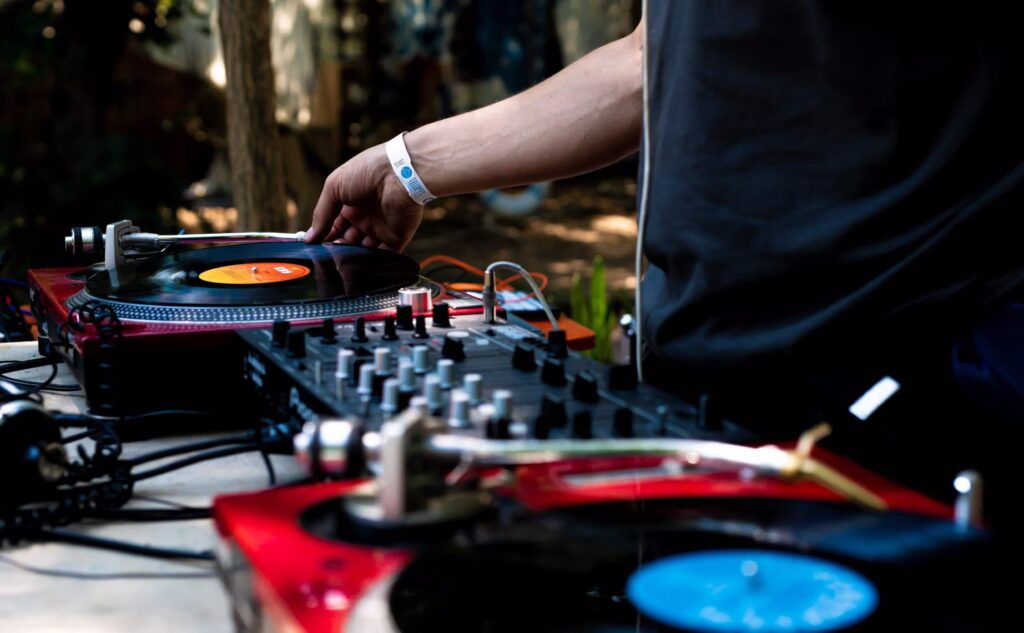
In this school of thought, the DJ’s primary presence remains auditory, not visual. They don’t need a microphone or a massive stage. They prove they are there by constantly riding the mix, layering multiple sparse tracks together to create a brand new, unique piece of music that only exists in that exact moment.
The mix is the performance. The DJ puts their head down and works the machines. They don’t ask for your adulation; they just demand that you listen to what they are creating. In a landscape dominated by the attention economy and social media spectacle, putting your head down and just doing the work is the ultimate rebellion against the ego. When the DJ removes themselves as the visual focal point, it gives the crowd permission to stop staring at the booth.
The Verdict
Whether this current social media push is a genuine cultural shift or just a highly targeted algorithmic echo chamber, I find it hard to argue with the core message. Mark had it right two decades ago, and the purists have been defending it ever since.
The DJ is the engine of the night, but the dancefloor is the vehicle.
We don’t turn our backs to disrespect the person playing the records; we do it to close the circle. We do it to rebuild that feedback loop of energy and transform back into a singular, breathing entity.
The next time you are at a club, try a simple experiment. When the music drops, turn around. Turn your back on the stage setup. Face your friends. Face the strangers standing next to you. You stop consuming a performance and start actively participating in a shared experience. Let the DJ do their job in the dark, put the phone away, and get back to the music.