
This is a bit of a personal one. I don’t know if every electronic music producer suffers from this specific cycle, or if it is just a quirk of my own brain, but I have always profoundly struggled with promoting my own music.
If you look at the modern music industry, production is only half the job. You are expected to be a content creator, a social media manager, and your own biggest hype man. You are supposed to confidently push your tracks onto playlists, DJ promos, and social feeds.
I have always found that friction incredibly difficult to navigate. However, the underlying reason why I struggle with it has recently undergone a massive, fundamental shift.
The Technical Mask
Until about a year ago, the reason I didn’t promote my music was simple: listening back to it, I just didn’t like it very much.
The frustrating part was that this had absolutely nothing to do with a lack of technical ability. I wasn’t a bedroom producer just trying to figure out how a compressor worked. I spent years working at the sharp end of the pro-audio industry. I ran commercial studios, mastered audio for clients, provided national technical support for high-end gear, and even cut physical dubplates on a lathe. I taught classes on this stuff. While travelling internationally, I interviewed some of the biggest legends in the (my) world about how they achieved their sound.
I knew exactly how to make a track sound “good.” My mixes were great, the low-end was tight, and the transients were clean.
But none of that mattered. No matter how perfectly engineered the final exported file was, I still felt a massive, hollow disconnect from it.
It is the classic trap of the high-functioning neurodivergent: you learn how to mask the internal chaos by mastering the external mechanics. It didn’t matter how flawlessly I made it sound; something inside me still didn’t like it. Because I couldn’t connect with the product on a fundamental, emotional level, I felt like a fraud trying to promote it. So, polished, finished tracks just died on the hard drive.
But recently, something shifted. Strangely, I seem to be liking what I am putting out a lot more.
The Psychological Bottleneck
It might be a coincidence, but this sudden appreciation for my own art perfectly aligns with the end of a very long, very difficult personal chapter.
I just recently finished around four years of intensive, weekly therapy.
I spent those years doing the heavy lifting to deal with – what I now know to be – PTSD, an anxiety disorder, and dissociative personality disorder.
I want to be clear: this is not me claiming I have it all completely sussed out. Managing my mental health is a reality I will likely have to remain actively aware of for the rest of my life. But gaining genuine insight into the root causes finally allows me to stop being so ruthlessly hard on myself. That is the ironic, evil twist of an anxiety disorder: you start getting anxious about the fact that you are anxious, which just burrows you further down into the hole. Understanding the mechanism finally helped break that cycle.
When you spend your life navigating a dissociative state or a heavy layer of anxiety, your entire identity is fragmented. You are constantly wearing masks. (I wrote previously about the danger of letting a noun, like “DJ,” become your entire identity). When your sense of self is that fragmented, how can you possibly expect your music to sound cohesive? How can you write something that sounds “like you,” when you are actively struggling to figure out who “you” actually are?
Therapy is the process of integration. As I did the work to untangle the PTSD and drop the anxiety, the mental noise quieted down. And as the internal noise dropped, the music I was writing suddenly started to make sense.
I stopped trying to write what I thought a “House Producer” should write, and I just started playing with the machines. Unsurprisingly, when the mind heals, the art improves. For the first time in a very long time, the music actually sounds like me, I think. 🤣
The Speed of Creation
So, I finally like my own music. The psychological hurdle to self-promotion is gone. Problem solved, right?
Not exactly. Now, there is a brand new, entirely pragmatic issue: I produce too quickly.
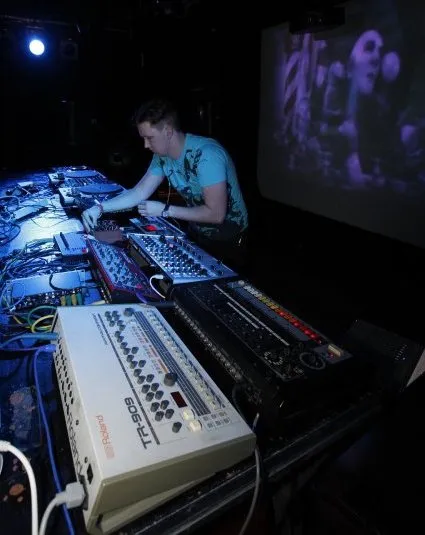
When you strip away the mental friction, the workflow speeds up exponentially. Because I treat my DAW like a tape machine and rely heavily on physical hardware to write the sequences, I am constantly generating new ideas. I am always working on something new, which means my output is vastly outpacing my ability to release it.
I find myself loading up an “older” tune to prepare it for release—and in my current workflow, an “older” tune usually means it was written last month. By the time I listen to it again, the excitement is completely gone. I have already moved on. In the four weeks since I wrote it, I have learned a new production trick, integrated a new piece of hardware, or simply shifted into a completely different emotional space.
I end up preferring the new stuff I wrote yesterday to the “finished” track from last month. Because the old track no longer represents where I am right now, I lose the motivation to promote it.
The Drive and the Disconnect
All of this raises a highly valid, existential question: If I am writing purely for myself, and I am finally comfortable doing exactly what I want in the studio, why do I feel the need to release anything at all?
The truth is, art is a conversation. No matter how comfortable you get in your own isolated creative bubble, there is still a fundamental human drive to be heard, to share the output, and to have it enjoyed by others.
But that drive creates a bizarre paradox when people actually do listen.
I regularly have people reach out to tell me how much they still love a specific older track or a DJ mix from years ago. Internally, I struggle to even accept that old audio as a ‘part of myself’ anymore. Because my identity and my technical skills have shifted so drastically, it feels like listening to a stranger.
I have to constantly remind myself that the listener does not share my timeline, and they do not share my hyper-critical ear. The subjectivity of music is wild. A track I view as a flawed, throwaway experiment might deeply resonate with someone else. Conversely, the tracks I consider my absolute masterpieces—my ‘babies’—might not tickle the fancy of the dancefloor at all.
The Process over the Product
I am still trying to figure out how to reconcile this.
Maybe the solution is to abandon the traditional release cycle entirely. Maybe I just need to start dumping tracks onto Bandcamp the exact same day they are finished, capturing the energy while it is still fresh, algorithms be damned.
Or maybe, this isn’t an issue that actually needs fixing.
If finishing therapy has taught me anything, it is that the process is far more important than the product. I am in the studio making music because I genuinely love the physical act of making music. I love patching the cables, writing the grooves, and exploring the sound.
If I write a track, enjoy the process, and then abandon it a month later because I have moved on to something better, that isn’t a failure in marketing. That is just the sound of forward momentum.