

If you built computers in the late nineties or early two-thousands, you remember the fear. The manuals terrified you into believing that simply looking at a motherboard the wrong way would instantly fry the CPU. We were told to buy anti-static grounding straps, clip them to our wrists, and stand perfectly still on hard floors.
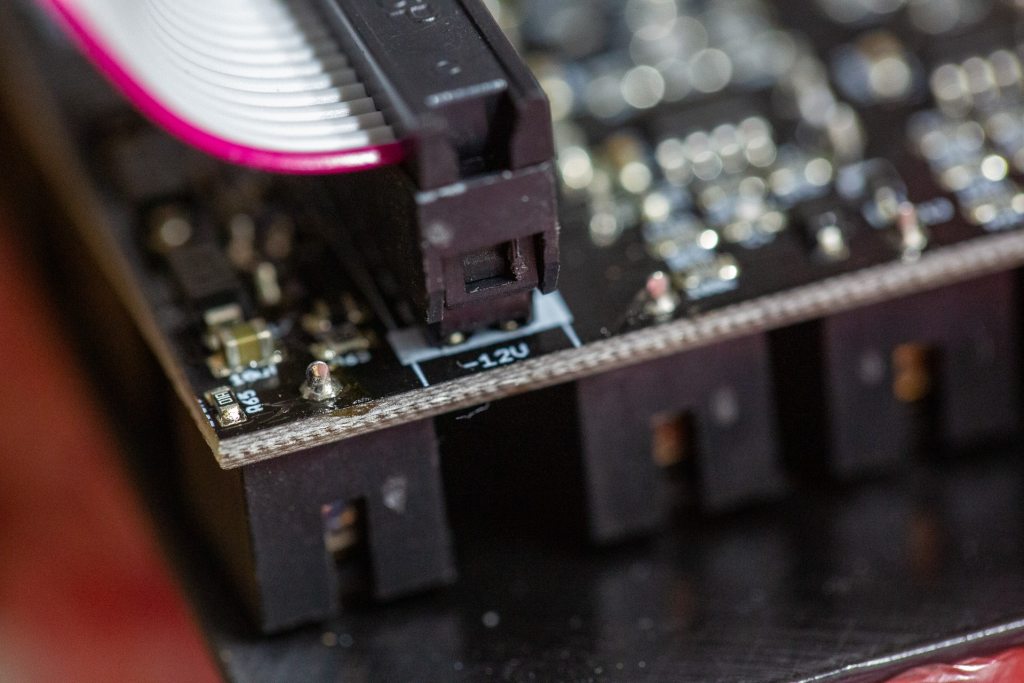
As you move into the world of physical modular synthesis, you are suddenly handling exposed Printed Circuit Boards (PCBs) again. Every time you buy a new Eurorack module, you pull it out of a static-shielding bag, staring directly at rows of unprotected resistors, capacitors, and microprocessors.
It begs an obvious question: how worried do you actually need to be about static electricity when building a modular synth?
The short answer is that you need to be careful, but you do not need to be paranoid.
The Faceplate Rule
The simplest way to avoid Electrostatic Discharge (ESD) damage is to never touch the PCB in the first place.
Every Eurorack module has an aluminium or fibreglass faceplate. This is your handle. When you pull a module out of its box, hold it by the edges of the faceplate. When you are plugging the ribbon cable into the back, grip the sides of the panel.
There is absolutely no reason for your fingers to be resting on the green (or black) fiberglass of the circuit board, and there is certainly no reason for your thumb to be pressing directly into an integrated circuit chip. If you make it a hard operational rule to only touch the front panel and the sides of the module, your risk of zapping a component drops to near zero.
Modern Protection vs. Digital Brains
The electronic components manufactured today are significantly more resilient than the fragile chips we were handling twenty years ago. Many modern analog components have built-in ESD protection. They can take a minor static hit without instantly dying.
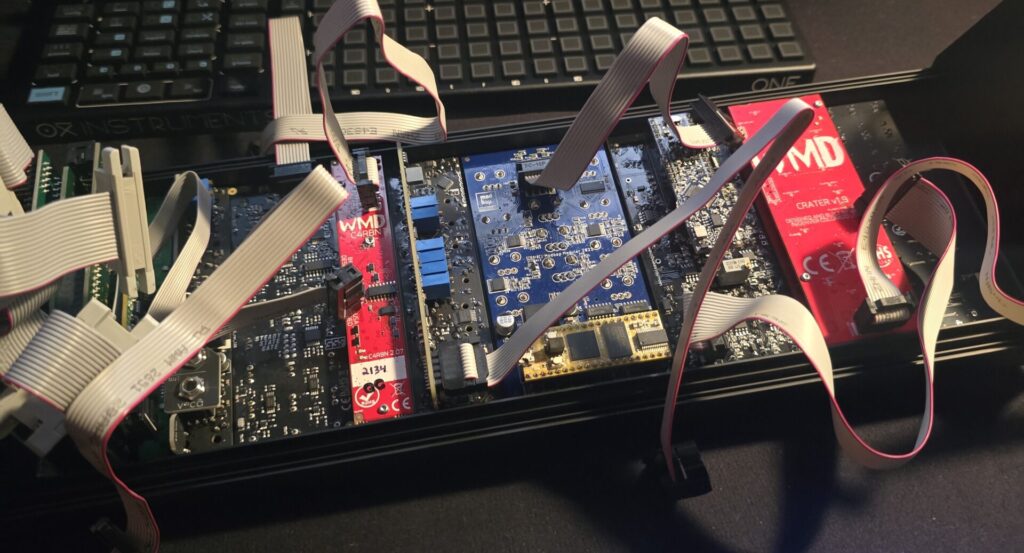
However, the Eurorack landscape has changed. Ten years ago, most racks were entirely analog. Today, a massive percentage of modules—complex oscillators, granular delays, and matrix mixers—are essentially tiny, highly specialized computers. They rely on sensitive microprocessors and RAM chips.
Digital modules are much less forgiving of static shocks than analog circuits. If you send a jolt of static electricity from your finger directly into the brain of a digital reverb module, you can absolutely permanently scramble the chip.
The Practical Grounding Method
You do not need to wear a grounded wrist strap to screw a module into your case. That level of precaution is reserved for people who are actively soldering and building DIY modules from scratch at a workbench.
For standard rack assembly, you just need to practice basic electrical hygiene.
Before you pull a module out of its anti-static bag, reach out and touch the metal rails of your Eurorack case (assuming the case is plugged into the wall and turned off, which grounds the chassis). This simple action discharges any static build-up from your body into the earth ground.
The Cleaning Trap
Eventually, your rack is going to get dusty. The immediate instinct is to grab the household vacuum cleaner or a standard dusting cloth and go to work on the faceplates and the gaps between the modules. This is a massive mistake.
Standard vacuum cleaners generate a huge amount of static electricity at the plastic nozzle. Waving a running vacuum hose over an exposed rack is a brilliant way to arc a shock directly into a module. Standard microfibre cloths can also build and hold a significant static charge.
If you need to clean the system, power it down entirely and unplug it from the wall. Use a dedicated anti-static brush—the kind used for camera lenses or PC building—to gently sweep the dust off the hardware. If you must use canned compressed air, keep the can perfectly upright to avoid blasting freezing liquid propellant onto the components, and do it from a distance. Again, the faceplate rule applies: you are cleaning the metal panels, not scrubbing the circuit boards behind them.
The Winter Hazard
You need to be acutely aware of your environment. In a standard New Zealand winter, we close the windows, turn on the heat pumps, and dry out the air. Dry air is the perfect breeding ground for static electricity.
If you are wearing a wool jersey, shuffling across a synthetic carpet in your socks, and you reach directly for a bare PCB, you are asking for a failure. The resulting spark will carry thousands of volts. It might not have high amperage, but that sudden voltage spike is more than enough to blow out a micro-controller.
Respect the hardware. Ground yourself on the case rails, hold the gear by the faceplate, keep the vacuum cleaner away from the rack, and stop treating exposed circuitry like it is made of indestructible plastic.