

One of the most tedious, but necessary, evils of migrating to a new studio setup is the admin work. If you want to actually write music, you need to eliminate the friction of creating a work environment every time you sit down. You need a default template.
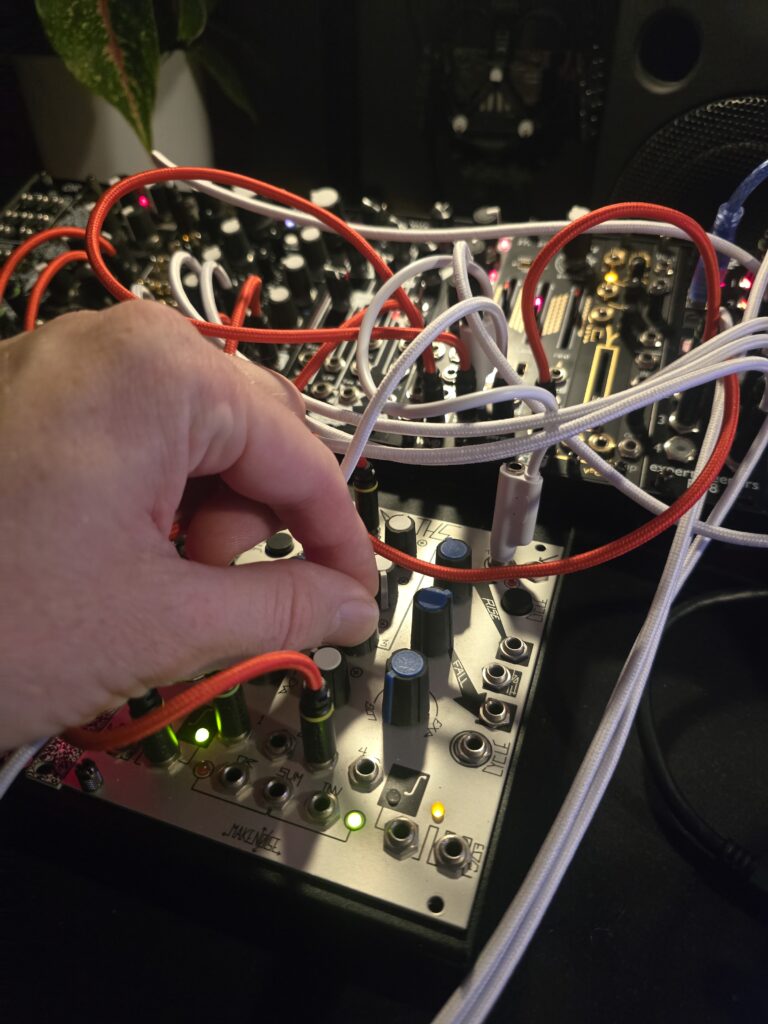
Last night, I was deep in the admin phase in Ableton. I was routing inputs, labelling channels, and setting up the master bus. To test the signal flow, I patched into the WMD Crater on my Eurorack rig. The Crater is a dedicated, heavy-hitting analog kick drum module. I expected to hear a tightly tuned, aggressive low-end thump.
Instead, my headphones were instantly flooded with a massive, swelling, cavernous reverberant pad.
As a quick aside: the combination of the Topping DX5 II and the new HiFiMan Anandas is proving to be absolutely phenomenal. The Anandas are massive—both in physical size on my head and in the sheer scale of the soundstage they produce. Hearing this unexpected wash of sound open up inside those planar magnetic drivers was an incredibly visceral experience.
I had absolutely no idea what was happening. I initially assumed it was a physical routing error in the patch cables, or a feedback loop on the desk I hadn’t accounted for.
As it turns out, the ghost in the machine was entirely user error. While building the default template, I had accidentally dropped a giant, algorithmic reverb plugin—set to 100% wet—directly onto the input channel instead of a basic DC offset filter. Every single transient I sent from the modular rig was instantly swallowed, washed out, and swirled around in an endless cinematic tail before it even hit the timeline.
The Troubleshooting Instinct
If you have spent your life in pro audio or IT, you have a hardwired response to an operational anomaly: Stop and fix it. My immediate instinct was to pull the cables, check the Ableton I/O settings, and find the routing error. I was about to kill the audio entirely to solve the math problem.
Then, I stopped. I realised it sounded incredible.
I made a deliberate, conscious decision to abandon the troubleshooting mindset. I was terrified that if I touched a single knob or bumped a patch cable, I would break whatever accidental feedback loop I thought was causing this glorious mess.
Instead of fixing it, I scrambled to hit record.
Operationalising the Accident
Capturing ephemeral moments is the hardest part of working with physical hardware. If you don’t have a track armed, the moment vanishes into the ether.
Because I was already in the process of building my default Ableton template, I immediately added a dedicated, permanently armed “Resampling” audio channel to the rig. It sits there, catching whatever is passing through the master bus. (I am also looking into picking up the ‘Rolling Sampler’ plugin—a brilliant utility that constantly records audio into a background buffer, allowing you to retroactively drag and drop the last few minutes of audio onto your timeline even if you forgot to hit record).
With the audio safely printing to the hard drive, I spent the next half hour in absolute bliss.
I stopped worrying about song structure. I just played. I slowly manipulated the knobs on the Crater. I unplugged a cable, and then spent ten minutes rhythmically causing audio pops and crackles by only half-plugging it back into the jack, riding the electrical short-circuit like an instrument. I tried weird, nonsensical routing just to see how the massive reverb would react to the sharp transients.
It was a mistake, but it was a massive revelation. This accidental “fully wet input” setup gave me the exact oceanic, diffuse texture I have been chasing for years. It was a direct, accidental shortcut to the classic Basic Channel and dub techno sound I idolise.
The DAW Deficit
Would I have done this if I was working entirely “in the box”?
Absolutely not. I can state that as a proven fact, because for the last ten years of being entirely computer-based, I haven’t done it once.
In a DAW, an error is usually just a crashed plugin or a harsh, unmusical digital clip. You don’t “play” a digital routing error. But in the physical, electrical world of modular synthesis, an error is just an unplanned voltage. It has physical weight, resistance, and life. You can interact with it with your hands.
Sitting there, manipulating that hardware through a wall of digital reverb, I had a sudden flashback. The last time I lost myself like this was probably fifteen years ago. I had rigged up a rudimentary feedback circuit using just an analog mixer and a guitar distortion pedal. I sat on the floor for what felt like hours, riding the chaotic oscillation of the pedal.
Eventually, the door opened and my partner at the time walked in. She politely—but firmly—asked me to stop. In hindsight, I can’t blame her. To me, I was exploring the microscopic tearing of audio frequencies. To her, I had been blasting the sound of a broken audio feed through a massive set of studio monitors for thirty minutes straight.
The Self-Induced Expectation
When I finally stopped recording last night and took the Anandas off, I was left with a strange realisation.
I had just spent an incredibly rewarding evening doing nothing but sculpting an ambient soundscape. I used to DJ ambient music. I have spent countless hours in my life lying in the dark with headphones on, listening to drone and ambient albums.
So why haven’t I ever released any?
Why have I spent years trying to force myself to write standard 4/4 tech-house or dub techno, when the most fun I have in the studio happens when the kick drum disappears entirely?
We build these massive, self-induced expectations of what our output should sound like. We decide we are a “techno producer” or a “house head,” and we box ourselves into a rigid grid. We try to make products for a dancefloor we don’t even go to anymore, completely ignoring the fact that the actual joy of the studio is just playing with sound.
The WMD Crater error was a massive wake-up call. I am not going to delete that 30-minute recording. I am going to chop it up, layer it, and finally embrace the fact that maybe the music I should be making isn’t meant for a club at all.